



Why use our A Level Simulators?
Immersive learning
Deepen your understanding of your A Level subject by putting yourself in the shoes of decision-makers.
Enjoy your learning
Not all learning needs to be boring. A Level Simulators are just one of Study Dog's fun and interactive resources.
Learn tough topics
Our A Level simulators are built from topics across your courses, including some of the toughest topics.
About Study Dog's A Level Simulators
Many studies have shown that adding a gamified element to your learning can enhance education outcomes. A Level Simulators add to our collection of gamified learning resources, including our achievements features.
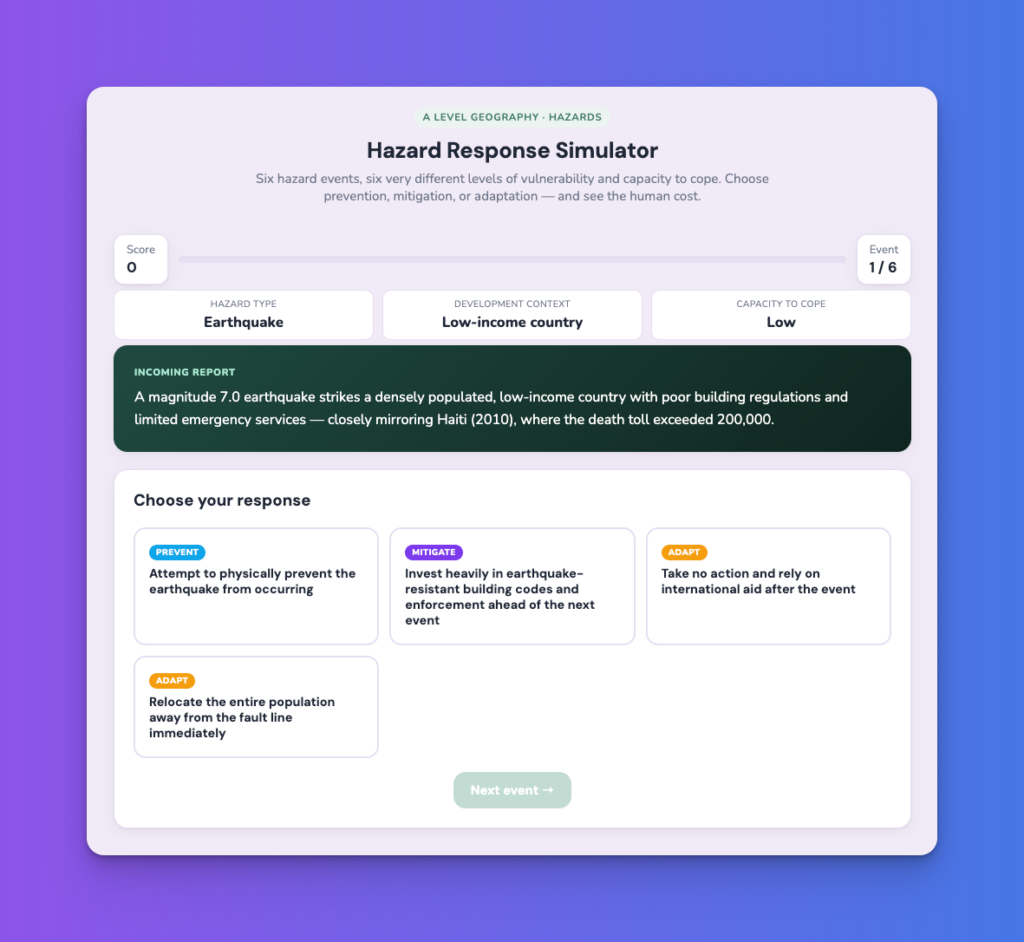
Our A Level Simulators are an immersive experience that allow you to dive deep into your revision and learning. From forming new governments to aiding recovery following a natural disaster, check out our A Level simulators below.
Economics
You’ll set a price or income change for a good and predict the effect on quantity demanded for that good and its substitutes/complements, then see the actual curve shifts and revenue implications, making elasticity concepts tangible and quantitative.
A market with an externality (pollution, education, healthcare) is presented, and you choose an intervention: tax, subsidy, regulation, tradable permits. You’ll then see the welfare diagram update, including whether the intervention overshoots or undershoots the social optimum.
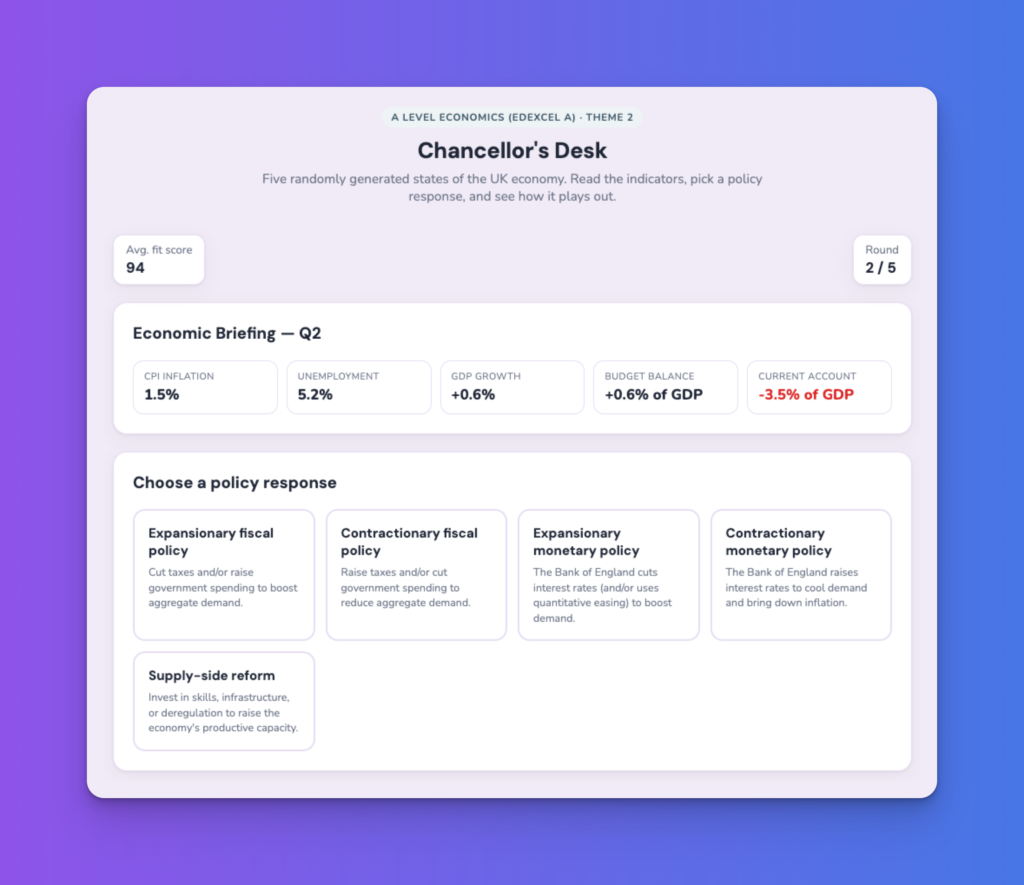
Given a scenario (rising inflation, high unemployment, a demand shock), you’ll choose fiscal or monetary policy levers and watch the AD/AS diagram and key indicators respond, including unintended trade-offs like the Phillips curve relationship.
A firm’s scenario is described and you classify it as perfect competition, monopolistic competition, oligopoly, or monopoly, then predict its pricing and output behaviour and see how it compares to the model’s predictions.
You apply a shock (an interest rate rise, a tariff, a change in relative inflation) and predict the effect on the exchange rate and the trade balance, connecting the Global Perspective content on international trade and the balance of payments.
Given a firm’s cost and revenue data, you choose which objective it’s pursuing: profit maximisation, revenue maximisation, satisficing. You’ll then see how that choice changes the price and output decision on the diagram.
Geography
Manipulate inputs like rainfall, deforestation, or urbanisation and watch stores (soil moisture, biomass, atmosphere) and fluxes (infiltration, evapotranspiration, respiration) respond, making the systems diagrams from the spec dynamic rather than static.
You’re given a deprived urban area’s stats, pick a regeneration strategy (property-led, community-led, state-led) and see the trade-offs across economic, social, and environmental sustainability, plus who gets displaced.
PE
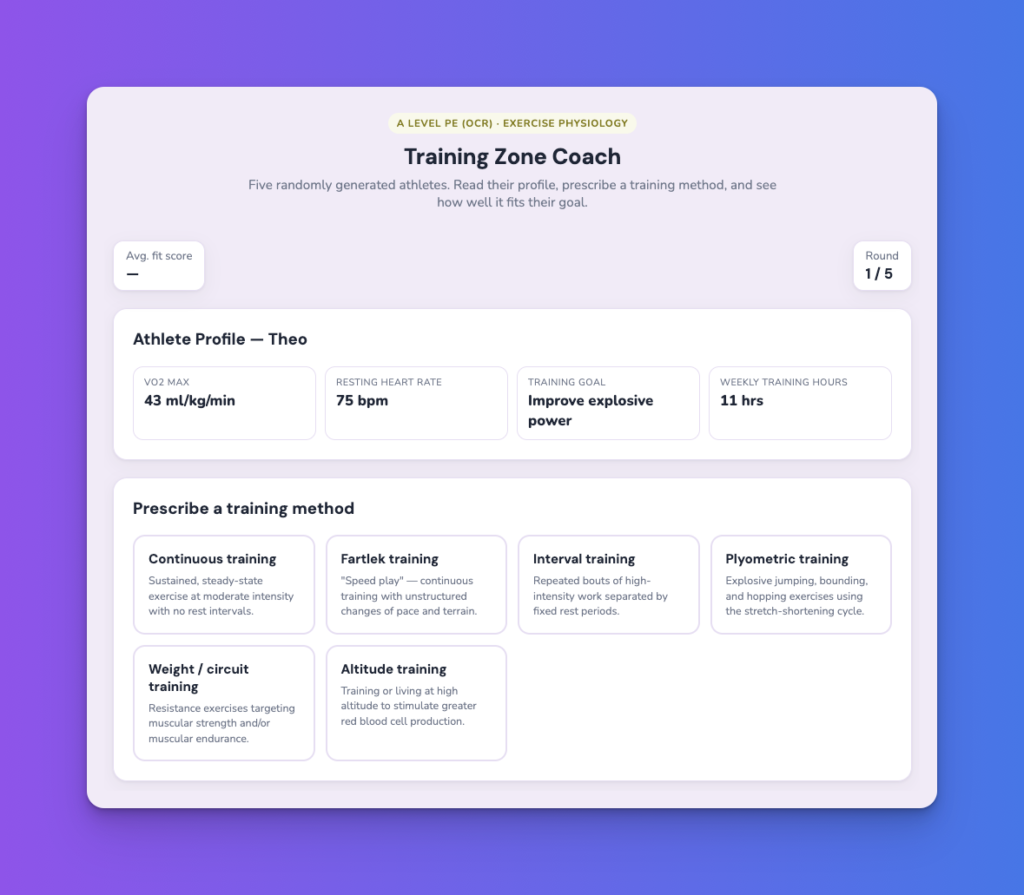
An athlete scenario under competitive pressure is presented, to which you’ll apply theory (arousal, anxiety, aggression, personality) to predict how performance will be affected, then see the outcome against the Inverted-U or catastrophe theory predictions.
Given a learner’s stage of learning (cognitive, associative, autonomous), you’ll choose a practice structure, feedback type, and guidance method, then see the resulting rate of skill development.
A scenario about access, funding, or media coverage of a sport is presented and students apply concepts like commercialisation, deviance, or ethics to predict participation and public response.
Politics
A short scenario or policy statement is presented (a proposed law, a political speech, a real event) and you pick which Core Political Ideas thinker (liberal, conservative, socialist, and their sub-strands) would most approve or most object, then sees a breakdown of why other thinkers landed differently on the same case.
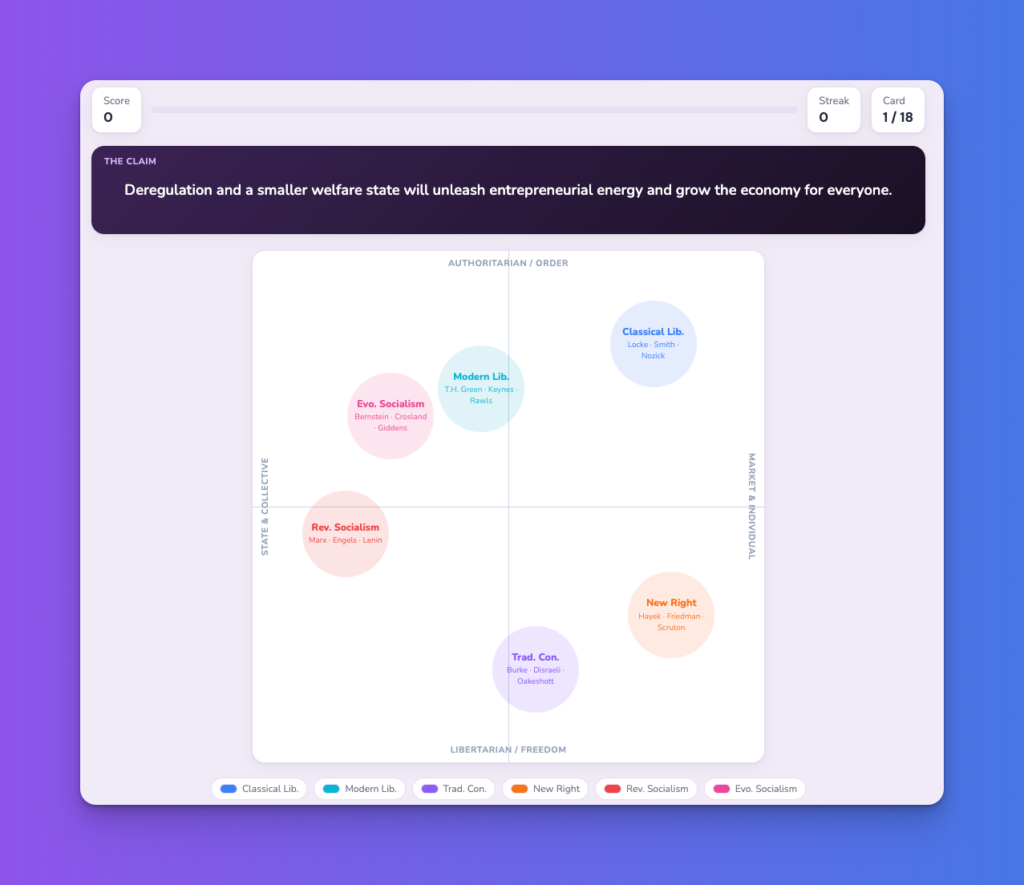
You drag a set of policy positions onto a spectrum and are then shown how classical liberals, modern liberals, One Nation and New Right conservatives, and different socialist strands would actually place them, surfacing the internal disagreements within each ideology rather than treating them as blocs.
Given a set of fictional general election results, you form a government (coalition, confidence-and-supply, or minority) and see the consequences for legislative power, mandate, and stability, tying directly into UK Government content on the electoral system and executive-legislative relations.
A fictional case is presented (a minister’s decision, a piece of delegated legislation) and you need to decide whether it’s open to judicial review and on what grounds (illegality, irrationality, procedural impropriety), then see how a court would likely rule and why, reinforcing rule of law and separation of powers content.
The same constitutional flashpoint (an executive overreach, a rights dispute) is run through both systems in parallel: codified vs uncodified, entrenched vs sovereign, judicial review powers. You’ll see structurally why the two systems produce different outcomes from the same starting scenario.
You are given a state’s resources and options in an international dispute and must classify and deploy hard, soft, and smart power, then see how other actors respond, building intuition for the Global Politics content on power and the state.
Psychology
A scenario modelled on classic conformity and obedience research lets you manipulate variables (group size, unanimity, proximity, legitimacy of authority) and predict the resulting conformity or obedience rate before seeing what the research shows.
A Strange-Situation-style behavioural scenario is presented and you classify the attachment type, then see the theoretical predictions that classification makes about later development.
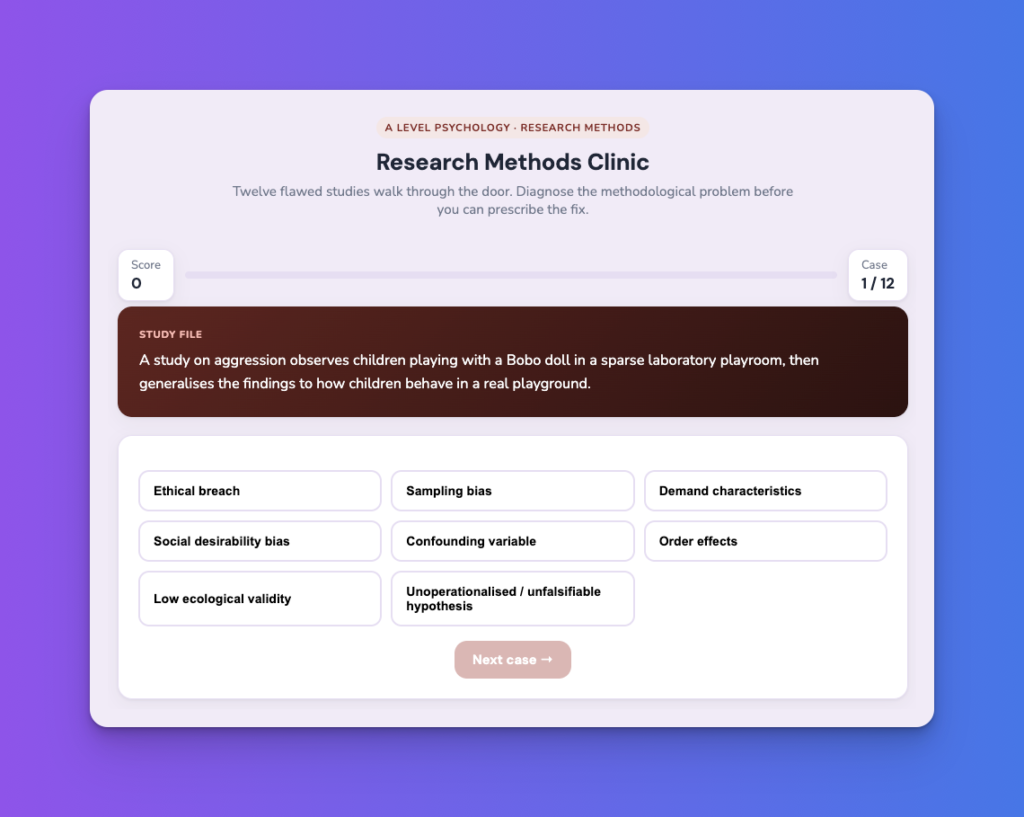
Given a hypothesis, you’ll choose an experimental design and controls, then see how their choices affect validity, reliability, and ethical standing, reinforcing content that’s assessed across every AQA Psychology paper.
A scenario is run through the core debates, including nature vs nurture, free will vs determinism, reductionism vs holism, ethical implications. You argue a position, then see the debate mapped against the specific psychological explanation involved.
Sociology
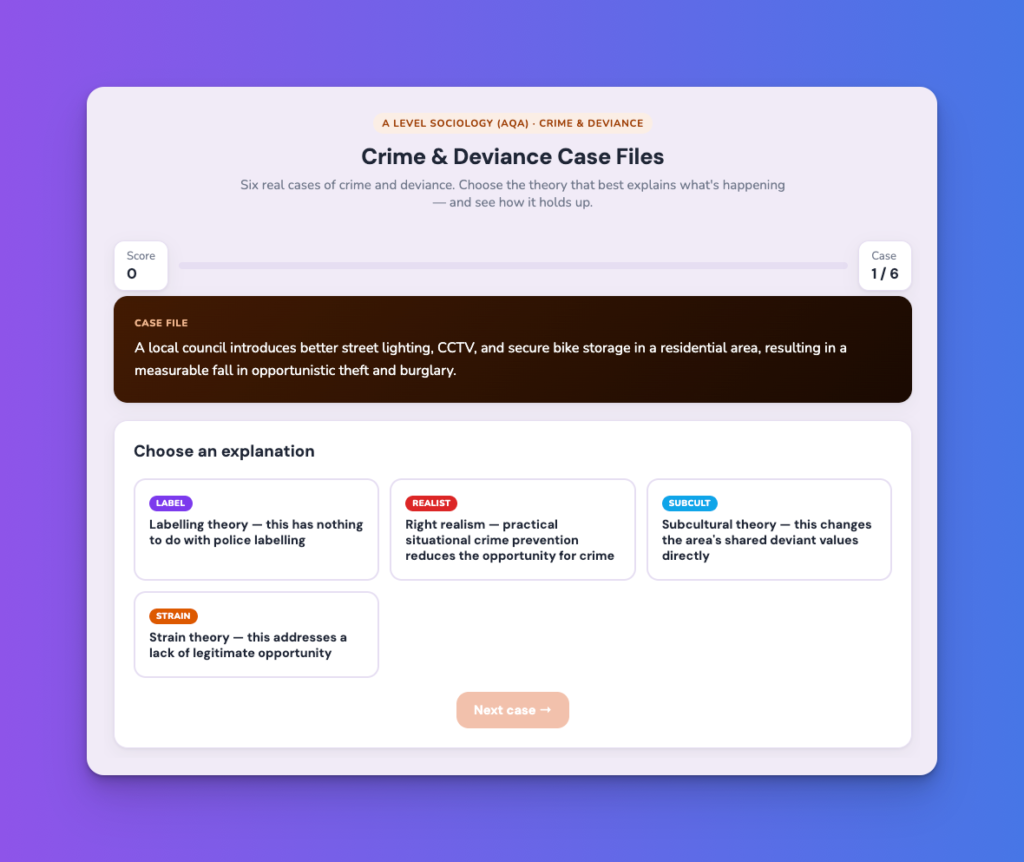
A crime scenario is presented and students apply a theoretical explanation (strain, subcultural, labelling, right realism, left realism) to explain why it happened and what response it’s likely to provoke, revealing how different theories point to very different policy responses.
Join Study Dog Now
With A Level Simulators and many more features included, become a Study Dog member today. You can get instant access and unlock your A* potential in your A Level studies right away!
All Memberships Include:
- Badges and Points
- Course Notes
- Multimedia Resources
- Personal Reports
- Interactive Simulators
- StudyBot AI Tutor
- and more!