Politics has a reputation for being confusing: jargon, acronyms, and people shouting about things that seem a long way from your life. It doesn’t have to be that way.
This is politics simplified: a plain-English guide to how UK politics actually works, written for A Level Politics students, and anyone who wants to finally understand what’s going on. This post is written by Leo Carr, a former A Level Politics teacher and the founder of Study Dog.
What is politics, in simple terms?
Politics is how groups of people make decisions together, and who gets to make them. When the government decides how much to spend on schools, when Parliament passes a law, when a student council votes on a new rule: that’s all politics.
Three words come up constantly in political discussion, so it’s worth understanding them now:
- Power: the ability to get someone to do something they might not otherwise do.
- Authority: the right to use power.
- Legitimacy: when people accept that right as rightful.
A government with power but no legitimacy is not an effective one. A government with all three is stable. Most political debates, from elections to protests, come back to one of these.
Who does what in UK politics?
UK politics is split into three branches, each with a distinctive role:
| Branch | Who is it | Their job |
|---|---|---|
| Legislature (Parliament) | House of Commons (650 elected MPs), House of Lords (appointed), the Monarch | Debates, scrutinises and passes laws; holds the government to account |
| Executive (government) | Prime Minister, Cabinet, ministers, civil service | Proposes policy and runs the country day to day |
| Judiciary (courts) | Judges and the Supreme Court | Interprets the law and checks the government acts lawfully |
Here’s the twist that makes UK politics different from other systems, like the USA: these jobs overlap. The Prime Minister and their ministers sit in Parliament, and the government usually has a majority in the Commons, so it can normally get its laws passed. That overlap is the root of some of the biggest A Level debates: is Parliament really sovereign (in charge), or is the executive too powerful?
How a law is made (without the jargon)
- First reading: the bill is introduced and read for the first time.
- Second reading: MPs debate the main idea behind the bill and vote on it.
- Committee stage: a small group of MPs goes through it line by line.
- Report stage and third reading: the whole Commons can propose changes, then holds a final vote.
- House of Lords: the bill goes through the same stages again. The Lords can suggest changes and delay a bill, but the Commons usually has the final say.
- Ping-pong: if the two Houses disagree, the bill bounces between them until they agree.
- Royal Assent: the monarch signs it and it becomes an Act of Parliament. This is a formality too. It hasn’t been refused since 1708.
Elections: how Britain picks its government
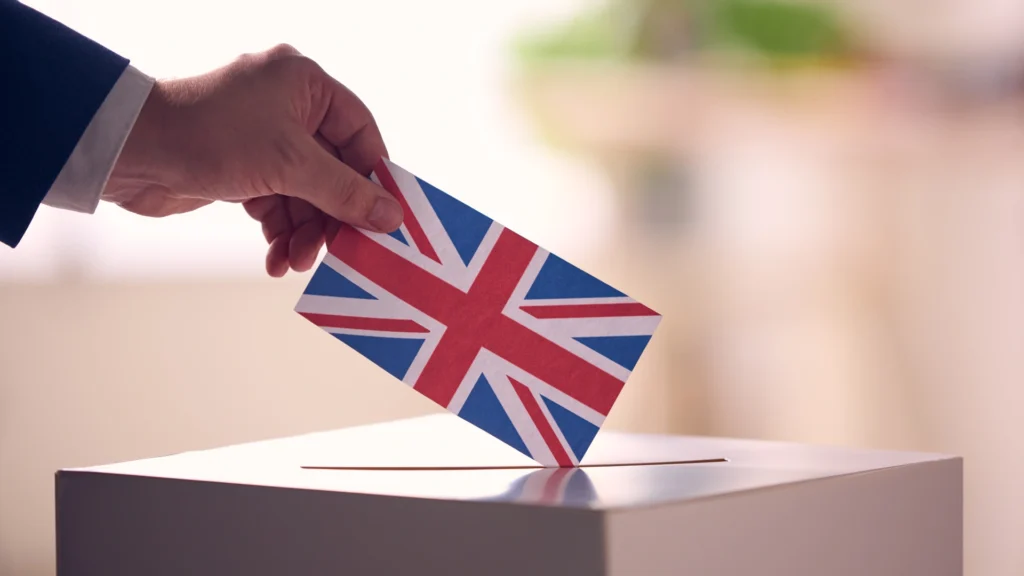
For general elections the UK uses the First Past the Post (FPTP) system. The country is split into 650 constituencies. In each one, the candidate with the most votes wins, even if that’s less than half. The party that wins a majority of seats (326 or more) usually forms the government.
The 2024 general election shows how this plays out. Labour won a large majority of seats on roughly 33% of the vote, while Reform UK won around 14% of the vote but only five seats.
That gap between votes and seats is why FPTP is such a popular essay topic. Here are the two sides:
- For FPTP: it tends to produce strong, stable single-party governments, a clear mandate, and a direct link between an MP and their constituency.
- Against FPTP: it’s disproportional, many votes don’t affect the result, and it favours big parties and regionally concentrated ones.
The UK doesn’t use FPTP everywhere. Other systems are used for the devolved bodies (for example AMS for the Scottish Parliament, the list system in Wales and STV in Northern Ireland), so always check which system a question is asking about.
The three core ideologies that shape politics
Ideologies are the “big ideas” behind political parties. A Level Politics study expects you to know conservatism, liberalism and socialism. Here’s the simple version:
| Ideology | Core idea | View of ‘the state’ |
|---|---|---|
| Conservatism | Change should be cautious. They value tradition, order and stability. | Needed to keep order, but shouldn’t try to remake society |
| Liberalism | The individual comes first: freedom, rights and consent. | Limited: it protects rights rather than running lives |
| Socialism | Equality and cooperation: the aim is to reduce inequality. | Active: it intervenes to create fairer outcomes |
Every ideology has internal splits (classical vs. modern liberalism, revolutionary vs. social democracy, traditional vs. one-nation conservatism). Knowing where thinkers within an ideology disagree is where the top marks are.
Why A Level Politics feels hard (and how to make it simpler)
A Level Politics is made up of three two-hour papers, each worth a third of the A Level, and the exams are essay-heavy. Marks come from three skills: knowledge (AO1), analysis (AO2) and evaluation (AO3). Most students lose marks on evaluation, which means weighing up arguments and reaching a judgement.
Four habits that make it far easier:
- Learn the debates, not just the facts. For every topic, know the “is it X or Y?” argument. Is the Prime Minister too powerful? Is FPTP fair? Does Parliament effectively hold the government to account?
- Collect fresh examples. A recent, real example beats an outdated textbook. Keep a running log of case studies as you go.
- Practice essays early: don’t wait until revision season. Timed essays with feedback are the fastest way to improve.
- Use active recall. Close your notes, write what you remember, then check. It beats re-reading every time.
How Study Dog helps
Study Dog’s A Level Politics course breaks every topic down into clear, plain-English lessons, so you’re never stuck deciphering a textbook. Alongside the lessons you get:
- Worksheets for every lesson, supplied in Word format so they work on a laptop or printed out.
- StudyBot, an AI tutor you can ask questions whenever you’re stuck.
- Quizzes and practice papers to test what you know before it counts.
Politics simplified: frequently asked questions
What is politics in simple terms?
Politics is how groups of people decide who gets what, who makes the rules, and how those rules are enforced.
Is A Level Politics hard?
It’s content-heavy and essay-based, so it rewards students who learn to build an argument. Students who keep up with current affairs and practise essays regularly usually find it much more manageable than expected.
What’s the difference between the government and Parliament?
Parliament passes and scrutinises laws. The government (the Prime Minister and ministers) proposes policy and runs the country. In the UK the government sits within Parliament, which is why the two are so often confused.
Do I need to follow the news for A Level Politics?
It’s highly recommended, because current examples make your essays more convincing. Reading the news for ten minutes a day, in the morning when you wake up, is best to see events play out.