A Level Sociology Exam Guidance: master essay technique
In AQA A Level Sociology, exam and essay technique goes beyond writing theories and studies. Study Dog’s A Level Sociology Exam Guidance course breaks down every aspect of your essay, from planning to writing, alongside analysis and evaluation techniques to master your 2027 A Level Sociology exams.



- Trusted by 3,000+ students
Our AQA A Level Sociology Exam Guidance
See exactly what’s on each of the three papers, how the marks are split and how long to spend per question. You’ll walk into the exam knowing the six question types and exactly how to pace yourself.
Learn what examiners mean by knowledge, application and evaluation, and how a mark is chosen from the level descriptors. Once you can see what each sentence of your answer is earning, you can write to climb the levels.
Learn what “outline”, “analyse” and “evaluate” really ask for, and how to spot the hooks in an Item. This avoids the most common way to lose marks: answering a slightly different question from the one set.
Secure all four marks in about six minutes with a simple identify-then-develop structure. You’ll learn to keep answers short and specific, with no introduction and no wasted words.
Master the “outline three” question with three short, clearly different points. You’ll see how to avoid repeating yourself and how Paper 1 and Paper 3 award the marks differently.
Turn two points into full-mark paragraphs by explaining them, adding evidence and saying why they matter. Worked examples from Beliefs in Society and Families and Households show the structure in action.
Find the two hooks in the Item and build each into a developed point, quoting the Item as you go. This is where most of the marks sit, and the lesson shows you how to claim them.
Learn five short analysis moves that take a point from description to the top band. Side-by-side weak and strong answers show the difference in just a few sentences.
Decode the Item to work out who you’re researching, where, and how sensitive the topic is. Applying a method to that specific setting is how you reach the top band on this 20-mark question.
A revision bank of the main research methods, with their strengths, limitations and how each plays out. It also covers the key concepts and the positivist and interpretivist views you need to link to.
Follow a 30-minute plan and a full worked answer on unstructured interviews and bullying. See how every paragraph stays tied to the method and the research issue.
Learn a three-minute plan that gives your essay a clear line, three points and a counter for each. It also covers timings and when to answer the 20-mark essay.
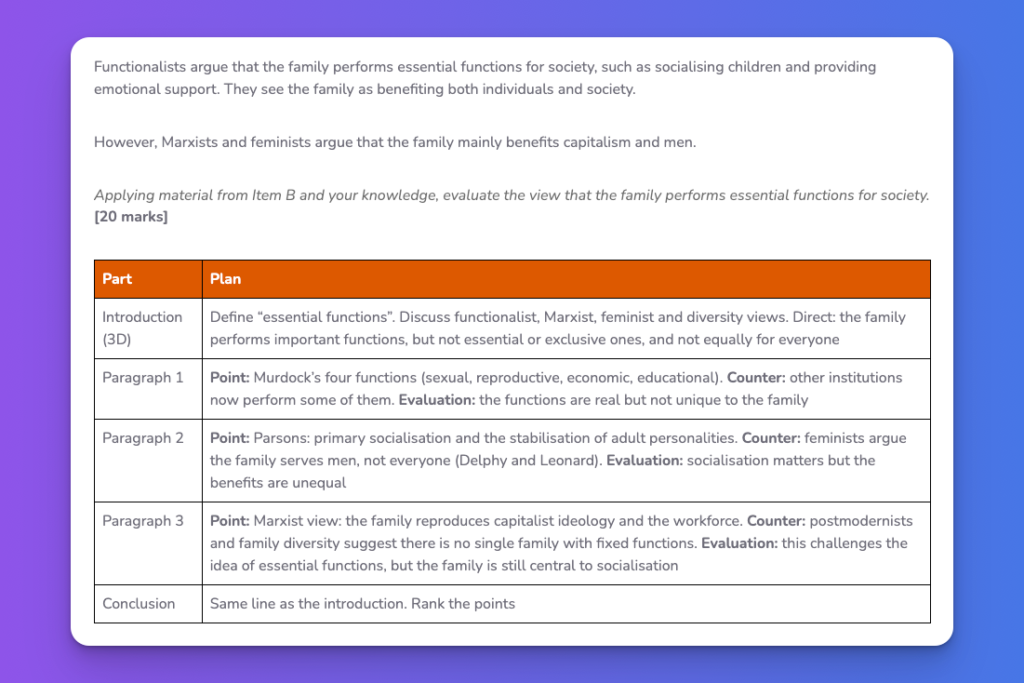
Move beyond the “block” approach with a thematic structure: 3D for introductions and PEACE for paragraphs. You’ll learn to put both sides of the debate in one paragraph and finish each with your own judgement.
Evaluation is the skill students find hardest, so this lesson breaks it into five clear ways to do it. You’ll see the difference between juxtaposition and a reasoned judgement, and how to use the Item’s hints.
Build the biggest question on Papers 1 and 3, from a short introduction to a ranked conclusion. A full worked example shows how each paragraph earns AO1, AO2 and AO3.
When a question names one theory, such as Marxism or realism, stay on that theory and use other perspectives only to test it. You’ll learn to avoid the classic trap of writing about the wrong theory.
For wide questions like the role and functions of education, learn to choose three or four angles and weigh them rather than list every theory. You’ll practise linking each point to the exact wording of the question.
Answer “two reasons” and “two problems” questions in two tight paragraphs, each with a concept and a named study. You’ll see exactly how to stop at two and still hit the top band.
Learn to plan debate-style essays on topics like social policy and whether sociology is a science. You’ll use real policies and studies, and both parts of the Item, to make your evaluation explicit.
The traps examiners flagged on the Education section in 2024 and 2025, from gender and achievement to parental choice. Each one comes with practical advice on what to write and what to leave out.
Learn the traps on Paper 3’s Crime section, from separating punishment and rehabilitation hooks to staying on the right theory. A knowledge checklist shows what to revise.
Work through the 2024 and 2025 questions on divorce, family diversity and childhood, and the mistakes examiners saw. You’ll learn to answer the question set, such as functions of the family and not gender roles.
The common slips in Beliefs, such as confusing New Age Movements with new religious movements or writing a general essay on secularisation. A worked example shows how a strong answer uses the Item and evaluates every point.
Why use A Level Sociology exam guidance?
A Level Sociology can be overwhelming for some students, and some don’t get the chance to look over essay technique and structure within their lessons. Examiners have reported in the past that essay structure is where some students fall down, despite knowing lots of facts.
Study Dog’s A Level Sociology exam guidance course is included in every Sociology membership, and breaks down each question type with examples and guidance, giving you the confidence to write your next A Level Sociology essay to the best of your ability.
The easy-to-follow lessons include opportunities to compare what you’ve learned with model answers, so you can see the guidance come to life.
Frequently Asked Questions about A Level Sociology exam guidance
It is a course in your Study Dog membership that teaches you how to answer AQA A Level Sociology exam questions, from short outline questions to 30-mark essays. It shows you how to plan and write each type of answer, use sociological evidence and earn marks against the AQA mark scheme.
Paper 1 is Education with Theory and Methods. The A Level Sociology exam guidance course shows how to approach each question type on the paper.
Paper 2 is Topics in Sociology. Most schools choose Families and Households, and Beliefs in Society. Some may choose some of the other options, but these are the most popular.
Paper 3 is Crime and Deviance with Theory and Methods.
AQA A Level Sociology tests core knowledge and understanding with 4- and 6-mark questions, responses to items in 10- and 20-mark essays, and longer responses have 20- and 30-mark questions. Our A Level Sociology exam guidance course goes through exactly how to answer each question type.
A top-level answer sets out the key sociological theories and evidence for and against the question, assesses their strengths and weaknesses, and reaches a supported conclusion. The A Level Sociology exam guidance course shows how to plan one in a few minutes and how to use the mark scheme’s levels.
Join Study Dog Now
With A Level Sociology Exam Guidance and many more topics included, become a Study Dog member today. You can get instant access and unlock your A* potential in your A Level studies right away! Try it free for 7 days, no risk.
One subject
Focus on the subject you need most.Limited time offer
-
Learn: notes, audio and flashcards
-
Practice: quizzes and assessment resources
-
Track & Improve: personalised reports and plans
Rated 4.5 from 21 reviews on Trustpilot, Google and other sources.
Two or more subjects
Every subject you take, one simple price.Limited time offer
-
All Learn, Practice & Tracking features included
-
Every subject you take, one flat price
-
Add subjects any time at no extra cost
Rated 4.5 from 21 reviews on Trustpilot, Google and other sources.