
Aggregate demand is one of the most important concepts to master in A Level Economics. However, many students struggle to piece together the different elements of aggregate demand. This blog post will outline aggregate demand and the different elements that it entails.
What is aggregate demand?
Aggregate demand (AD) is the total demand for goods and services in an economy at a given price level and in a given time period. Put simply, it is the total amount households, firms, the government and foreign buyers want to spend on a country’s output.
In A Level Economics, you’ll often see AD shown with this formula:
AD = C + I + G + (X − M)
Where:
- C = Consumption (household spending)
- I = Investment (spending by firms on capital goods)
- G = Government spending
- X = Exports
- M = Imports
The (X − M) part is called net exports.
Breaking down aggregate demand for A Level Economics
1) Consumption (C)
This is spending by households on goods and services, such as food, clothes, transport and entertainment. This is typically the largest component of aggregate demand in many economies. Consumption usually rises when incomes also rise, interest rates fall, consumer confidence improves or tax rates are reduced. This allows for more spending in the economy.
2) Investment (I)
Investment means spending by firms on capital goods, such as machinery, factories, new technology and equipment. It doesn’t mean buying shares in the stock market (when considering macroeconomic aggregate demand). Investment tends to rise when interest rates are low, firms are expecting higher future demand, business confidence is strong, and profits are rising.
3) Government spending (G)
This is spending by the government on goods and services, for example, on NHS services, education, infrastructure (like roads, railways and construction), and public sector wages. If the government increases spending, aggregate demand usually rises too.
4) Net exports (X − M)
- Exports (X) are goods and services sold abroad.
- Imports (M) are goods and services bought from abroad.
If exports are greater than imports, net exports are positive, and aggregate demand rises. If imports rise faster than exports, net exports fall, and aggregate demand may fall. Net exports are affected by things like currency exchange rates, global economic growth, competition from abroad, and inflation differences between countries.
The aggregate demand diagram
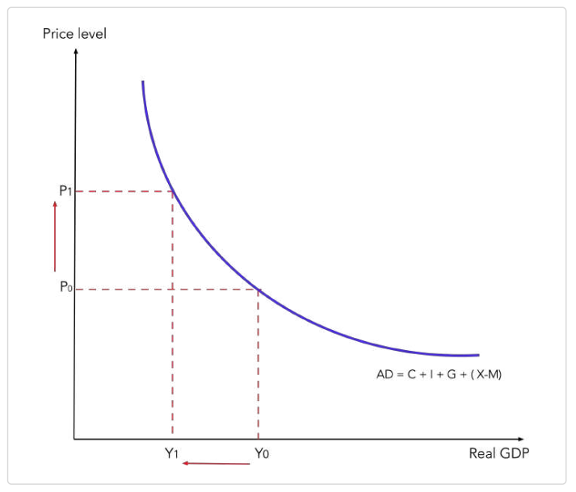
In A Level Economics, aggregate demand is shown as a downward-sloping curve on a graph with price level on the y-axis, and real GDP (national output) on the x-axis.
The first question that emerges is: why does the AD curve slope downwards? For A Level Economics students, there are three main reasons to understand:
- Wealth effect: If the price level falls, the real value of money rises, so households may feel wealthier and spend more.
- Interest rate effect: A lower price level can reduce the demand for money, which may lower interest rates, encouraging borrowing and spending.
- International competitiveness effect: If a country’s price level falls relative to other countries, exports may become more competitive, and imports may fall, increasing net exports.
What causes aggregate demand to change?
This is where A Level Economics students often get confused, so remember the difference:
- A change in price level leads to movement along the AD curve.
- A change in non-price factors leads to a shift of the AD curve. These factors can include lower interest rates, tax cuts, and changes in consumer confidence.
Example of aggregate demand in real life
Imagine that the British government cuts the income tax rate and the central bank also reduces interest rates. What might happen?
Households will have more disposable income at the end of each month, so the level of consumption rises. Borrowing now becomes cheaper due to lower interest rates, so consumption and investment also rise. Finally, firms become more optimistic about higher spending, so investment rises.
Overall, AD shifts to the right, real output may also increase, and the level of employment increases as market conditions become more favourable. However, the pressure of inflation may also increase if the economy is near full capacity.
You can use this thinking in your A Level Economics exams to demonstrate to examiners that you can think about aggregate demand in context and analyse the different effects it may have in certain scenarios.
How else can I learn about aggregate demand?
There are many common mistakes that students can make when looking at the aggregate demand curve in A Level Economics, including:
- Confusing AD with demand for one product
- Getting the formula wrong
- Mixing up movements and shifts
- Describing but not explaining
If you want to master the topic and know how to write it in an exam situation, then sign up for a Study Dog membership to get access to our A Level Economics resources. With audio and course notes, exam practice and model answers, we have everything you need to master your A Level Economics exams.