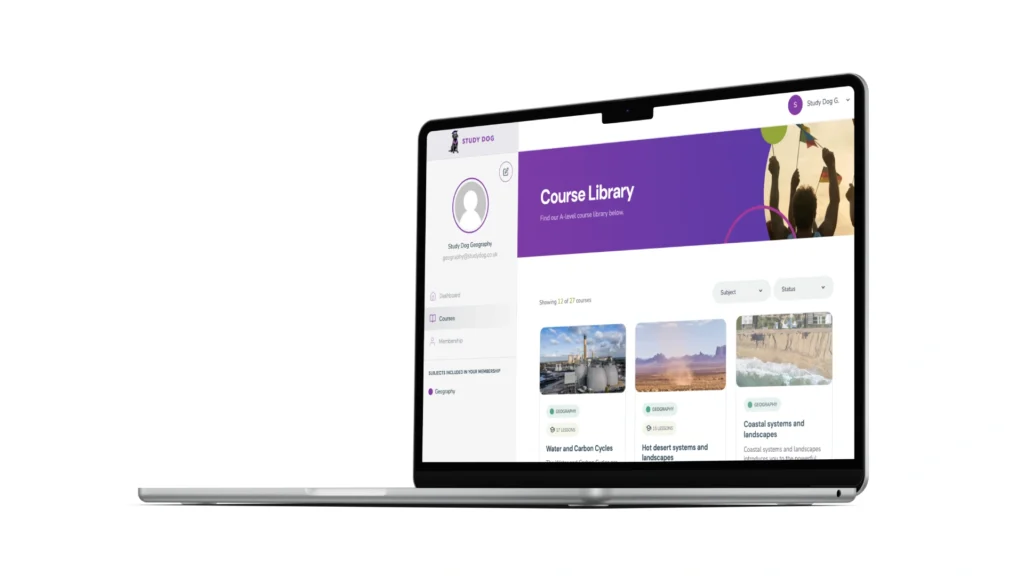
Sometimes the best solutions come from our own frustrations. That’s exactly what happened when Leo Carr, now founder of Study Dog, found himself struggling with A-level Politics revision despite loving the subject. This is the start of the Study Dog story.
Picture this: a school student who genuinely loves Politics but can’t motivate himself to study it. The traditional textbook-and-notes approach wasn’t working, even for someone passionate about the subject.
“I was studying for my A Level in Politics, my favourite subject,” Leo recalls. “I found myself struggling to motivate myself, even though I knew I loved the subject. Just reading a textbook and making notes wasn’t enough for me.”
The Search for Something Better
Leo’s dissatisfaction led him online, searching for revision tools that might work differently. But what he found was a fragmented mess of resources scattered across different websites and platforms.
What he really wanted was simple: “Just an online resource that spoke my language. A resource that broke topics down into easy chunks, one that used quick assessment tools like quizzes or flashcards. And a tool that had everything I needed in one place.”
That moment of searching and not finding what he needed became the spark for Study Dog. Founded in 2020, the platform started with A-level Politics resources designed specifically for students looking to improve their educational outcomes.
Speaking Students’ Language
But what does it actually mean for an educational resource to “speak a student’s language”? For Study Dog, it means understanding how modern students actually learn.
Take our video lessons, for example. Each one is capped at exactly 5 minutes. This isn’t arbitrary. “5 minutes is a good length to introduce topics and some key examples, before encouraging students to read further for more information,” Leo explains.
The approach acknowledges a reality that many educators struggle with: “Students’ attention spans are ever-decreasing, so having a good length of time for a video to introduce a topic felt important without overloading students with content.” Instead of fighting this trend, Study Dog works with it. The platform combines these bite-sized videos with audio notes, allowing students to engage with content in multiple ways without jumping between different tools or websites.
Recognition and Validation
In 2022, Study Dog won the ‘Next Big Thing’ award at the University of Exeter Student Startup Awards, along with grant funding from Santander Universities. For Leo, this recognition was more than just an achievement.
“Winning that award was a great achievement, and showed to me that people buy into the idea and the philosophy that I am building,” he reflects. “I saw that this is a model that can be applied to different subjects.” The award also highlighted something crucial about the education industry: “People see the need to apply this elsewhere in education, as it is an industry that fails to keep up with technology and trends.”
Technology That Actually Works
Leo’s critique of educational technology is particularly sharp. Most institutions assume that simply adding technology to classrooms automatically improves learning. Study Dog takes a different approach.
“Just putting a technology solution into a classroom isn’t good enough. Teachers need training, students need to adjust,” Leo points out. “Study Dog is an easy-to-use platform that can be embedded into a students’ workflow.”
The key difference is integration. Rather than forcing students to adapt to new systems, Study Dog fits into how they already work. Students can use the website as part of their revision, with progress tracking and achievements built into the same platform as the content.
“Adding features like progress tracking and quizzes into the same place as the content means students are more likely to use these resources as they don’t have to jump to other places to find them.”
Expanding Beyond Politics
Study Dog’s expansion tells an interesting story about learning itself. From Politics, the platform moved into Geography in 2024. Now, in 2026, Economics, PE and Sociology join the portfolio, with Psychology soon to launch.
That’s quite a leap from essay-based subjects to something as physical as PE. But Leo sees a common thread: “Our mission of enhancing student engagement remains the same.” The platform’s course notes are available in both text and audio formats, supporting students who may struggle to read or concentrate. For PE, this opens up exciting possibilities around non-examined assessments and coursework.
“Students need that support about how they can plan their physical or coaching performance. Going through the commonly-asked questions, and the actual process itself is going to be so helpful for many students that may not know where to start.”
The Real Problem We’re Solving
Through all these expansions and developments, a pattern emerges. Study Dog isn’t just about making content more engaging. It’s about solving a fundamental transition problem in education.
“It’s moving from being taught by a teacher to being independent,” Leo explains. “The process of moving from learning to revising is an important step, as students take ownership of their learning.”
This insight gets to the heart of what Study Dog actually does. It’s not just delivering information differently. It’s bridging the gap between passive learning and active revision, helping students develop the independence they need for academic success.
“Supporting them to find the revision methods they prefer, or by explaining complex topics easier is what we aim to do primarily.”
Looking Forward
Today, Study Dog serves A-level students aged 16 to 18, along with their parents. The platform also partners with schools through group memberships, making these resources available to entire student bodies.
The short-term focus remains on maximising exposure to students across existing subjects while building more school partnerships. But the long-term vision is bigger: international expansion to support other education systems and help close the global engagement gap.
What started as one student’s frustration with traditional revision methods has become a platform that prioritises engagement over everything else. The resources are designed to be loved by students, not just used by them. As Leo puts it, the core belief remains unchanged: “Students shouldn’t be held back from achieving their potential; each student should have access to engaging resources that allow them to reach their goals.”
Sometimes the best innovations come from the simplest insights. In Study Dog’s case, it was recognising that loving a subject and being able to study it effectively are two very different things. The platform bridges that gap, one five-minute lesson at a time.